


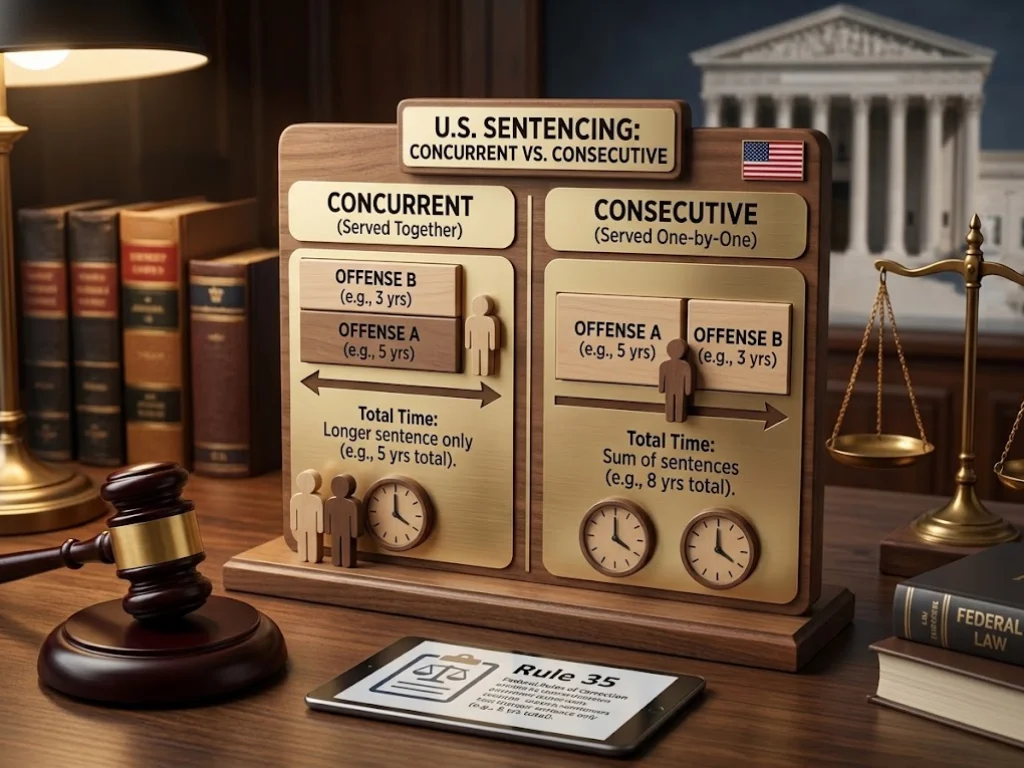
If you’re asking what’s the difference between concurrent and consecutive, the key distinction involves timing. Concurrent sentences run at the same time. Consecutive sentences run one after another.
That difference can change the total prison term by years. Two identical sentence lengths can produce dramatically different combined periods. The exact result depends on the judgment, applicable statutes, and sentencing rules.
Direct answer: Concurrent sentences are served at the same time, so overlapping terms generally end when the longest applicable term ends. Consecutive sentences are served back to back, so one term follows another. In U.S. criminal cases, the difference can substantially change the combined length of imprisonment.
Quick Comparison: Concurrent vs. Consecutive Sentences
| Question | Concurrent sentences | Consecutive sentences |
|---|---|---|
| How are they served? | At the same time | One after another |
| Do the terms overlap? | Yes | No |
| Does every term add fully to the total? | Usually no | Usually yes |
| Example: 5 years plus 3 years | Usually 5 years total | Usually 8 years total |
| Can federal law require one structure? | Yes | Yes |
| Can state rules differ? | Yes | Yes |
Key Takeaways
- Concurrent means multiple prison terms run during overlapping periods.
- Consecutive means one prison term follows another.
- A five-year and three-year concurrent sentence generally produce five years of combined imprisonment.
- The same terms served consecutively generally produce eight years.
- Federal courts apply statutes, sentencing guidelines, and other sentencing factors.
- State rules can differ from federal rules.
- Some federal offenses carry mandatory consecutive terms.
- A sentencing judgment controls the actual structure in an individual case.
What’s the Difference Between Concurrent and Consecutive Sentences?
A concurrent sentence overlaps another sentence for at least part of its duration. The defendant is therefore serving multiple terms during the same period. The longest overlapping term usually determines the combined endpoint. A consecutive sentence works differently because the terms are stacked. One sentence finishes before the next applicable term begins. This structure usually creates a longer combined period of imprisonment.
The difference becomes clearer with simple numbers. Suppose a judge imposes five years on one count and three years on another. The way those terms run determines their combined effect. With concurrent terms, both begin together in the basic example. The three-year term ends while the five-year term continues. The combined period is therefore five years. With consecutive terms, the three-year term follows the five-year term. The lengths are added rather than overlapped. The combined period becomes eight years.
A Simple Sentencing Example

Imagine a defendant receives four years for Count One. The defendant also receives two years for Count Two. Nothing about either individual sentence changes in this example. If the judge orders concurrent service, both terms run together. The two-year sentence finishes during the four-year sentence. The combined period would generally be four years. If the judge orders consecutive service, the two-year term follows the four-year term. The combined period would generally become six years. This example excludes credits, release rules, and other case-specific issues.
| Sentences imposed | If concurrent | If consecutive |
|---|---|---|
| 4 years + 2 years | 4 years | 6 years |
| 5 years + 3 years | 5 years | 8 years |
| 10 years + 5 years | 10 years | 15 years |
These calculations explain why sentencing language matters so much. The individual counts alone may not reveal the total structure. You must also know how the court ordered the terms to run.
How Federal Law Treats Multiple Sentences
Federal law addresses multiple imprisonment terms in 18 U.S.C. § 3584. When multiple terms are imposed together, they generally run concurrently unless otherwise ordered or required. Terms imposed at different times generally run consecutively unless the court orders concurrent service. That rule is not the entire federal sentencing analysis. A federal judge must also consider the sentencing factors listed in 18 U.S.C. § 3553(a). Those factors include offense circumstances, deterrence, public protection, sentencing ranges, disparities, and restitution.
The United States Sentencing Guidelines also address multiple counts. Section 5G1.2 explains how federal sentences on multiple conviction counts interact. Certain statutes can require a sentence to run consecutively. Readers exploring other court concepts can also review NewsHeck’s guide to summary judgment in U.S. civil cases. That subject concerns civil procedure rather than criminal sentencing. Still, it provides useful background on how federal legal rules shape court outcomes.
Can a Judge Choose Between the Two?
Federal judges sometimes have discretion over whether imprisonment terms run together or separately. That discretion is not unlimited. A statute can require a particular sentence to run consecutively. Section 3584 also directs courts to consider the federal sentencing factors. Those factors affect the court’s broader sentencing decision. They do not create one universal answer for every multi-count case.
The Sentencing Guidelines provide additional instructions for particular circumstances. Section 5G1.3 addresses defendants with an undischarged imprisonment term or anticipated state term. Some situations call for consecutive treatment, while others can support concurrent treatment. For more plain-English legal explainers, readers can browse NewsHeck’s Law section. It covers U.S. legal concepts alongside other law-related topics. The section can provide useful context before researching a specific jurisdiction.
Are Some Federal Sentences Required to Run Consecutively?
Yes, federal statutes sometimes require consecutive imprisonment. That means a judge cannot simply make every term overlap. The specific offense statute determines whether such a requirement exists. The 2025 federal guidelines identify 18 U.S.C. § 924(c) as one example. They also discuss mandatory terms under 18 U.S.C. § 1028A. These statutory rules can require additional imprisonment beyond another sentence. This point prevents a common misunderstanding about what’s the difference between concurrent and consecutive sentencing. The decision is not always a matter of judicial preference. Congress can mandate how particular federal terms interact.
What Does “Partially Concurrent” Mean?
Some situations can involve partially concurrent sentences. This means the terms overlap for only part of their duration. The resulting combined sentence falls between complete overlap and complete stacking. Federal sentencing guidance recognizes partial concurrency in certain circumstances involving existing imprisonment terms. The appropriate structure depends on the governing guideline and case facts. Section 5G1.3 specifically addresses several such situations. For example, a new sentence could overlap an existing term after a specified point. That creates neither a completely concurrent nor completely consecutive result. The written judgment and applicable law determine the real calculation.
Do Concurrent Sentences Mean Someone Is Punished Only Once?
No. Concurrent sentences remain separate sentences associated with separate counts or convictions. Their periods of imprisonment simply overlap. A person might therefore receive several convictions and several sentence terms. Concurrent service does not erase those convictions. It changes how the imprisonment periods operate together. This distinction matters because convictions can have consequences beyond incarceration. Those effects depend on the offense and applicable law. A criminal-defense lawyer can explain consequences tied to a particular judgment.
Do the Rules Work the Same Way in Every State?
No. State criminal sentencing is governed by state statutes, court decisions, and sentencing systems. Those rules can differ substantially across the United States. A state may establish presumptions or mandatory rules for certain crimes. Judges may also receive different levels of discretion depending on the jurisdiction. Federal rules should not automatically be applied to a state prosecution.
That distinction is important when reading national legal information online. Always identify whether a case is federal or state. Then check the rules governing that specific court. NewsHeck also explains courtroom roles in its guide to bailiffs and their duties. Court personnel and procedures vary by jurisdiction as well. That makes local context important across many legal questions.
Does Concurrent Always Mean “Exactly at the Same Moment”?
In everyday English, concurrent usually means occurring during overlapping time periods. Two events do not always need identical starting and ending moments. Legal sentencing adds specific rules governing when terms begin and how they interact. This is why the word should be read in context. Concurrent meetings, computer processes, and prison sentences can use the same basic concept. Their practical rules are different. Consecutive has a simpler timing idea across most contexts. One event follows another without being treated as simultaneous. In sentencing, that usually means terms are added sequentially.
Why the Difference Matters
The practical effect can be substantial. A defendant facing several counts may receive the same individual terms under either structure. Yet the combined imprisonment period can differ sharply. Consider three five-year terms. Full concurrency could produce a five-year combined period in a simplified example. Full consecutive service could produce fifteen years. Real cases can be more complicated than that calculation. Mandatory statutes, existing sentences, credits, release rules, and judgment wording can matter. Anyone evaluating an actual sentence should review the official judgment and applicable law.
The Bottom Line
Concurrent sentences run together, while consecutive sentences run one after another. That timing difference determines whether prison terms overlap or accumulate. It can substantially change the combined sentence. In federal cases, 18 U.S.C. § 3584 provides the basic framework. Federal sentencing guidelines and offense-specific statutes add further rules. State cases must be evaluated under the relevant state’s law. If you’re reviewing an actual criminal judgment, read the sentencing order carefully. Confirm whether each term is concurrent, consecutive, or partially concurrent. For case-specific advice, consult a licensed criminal-defense attorney in the relevant jurisdiction.
Frequently Asked Questions
What’s the difference between concurrent and consecutive prison sentences?
Concurrent prison sentences overlap, while consecutive prison sentences follow one another. The distinction determines how separate terms combine. It can therefore change the total period of imprisonment substantially.
Is a concurrent sentence shorter?
It often creates a shorter combined imprisonment period than full consecutive service. That does not mean the individual sentence terms disappear. Their time periods overlap instead.
Do consecutive sentences always get added together?
Fully consecutive terms are generally served sequentially. In a simple calculation, their lengths are therefore added. Actual release timing can involve additional legal rules and credits.
Can federal sentences run concurrently?
Yes. Federal law expressly recognizes both concurrent and consecutive imprisonment terms. The result depends on statutes, court orders, and applicable sentencing rules.
Can a judge make only part of a sentence concurrent?
Certain federal sentencing situations allow partially concurrent treatment. The terms then overlap for only part of their duration. Section 5G1.3 provides guidance for several circumstances involving other imprisonment terms.
Which is worse, concurrent or consecutive sentencing?
Consecutive service usually produces more combined prison time when the same sentence lengths are compared. The legal significance still depends on the complete judgment. Different charges may also carry mandatory sentencing requirements.
