


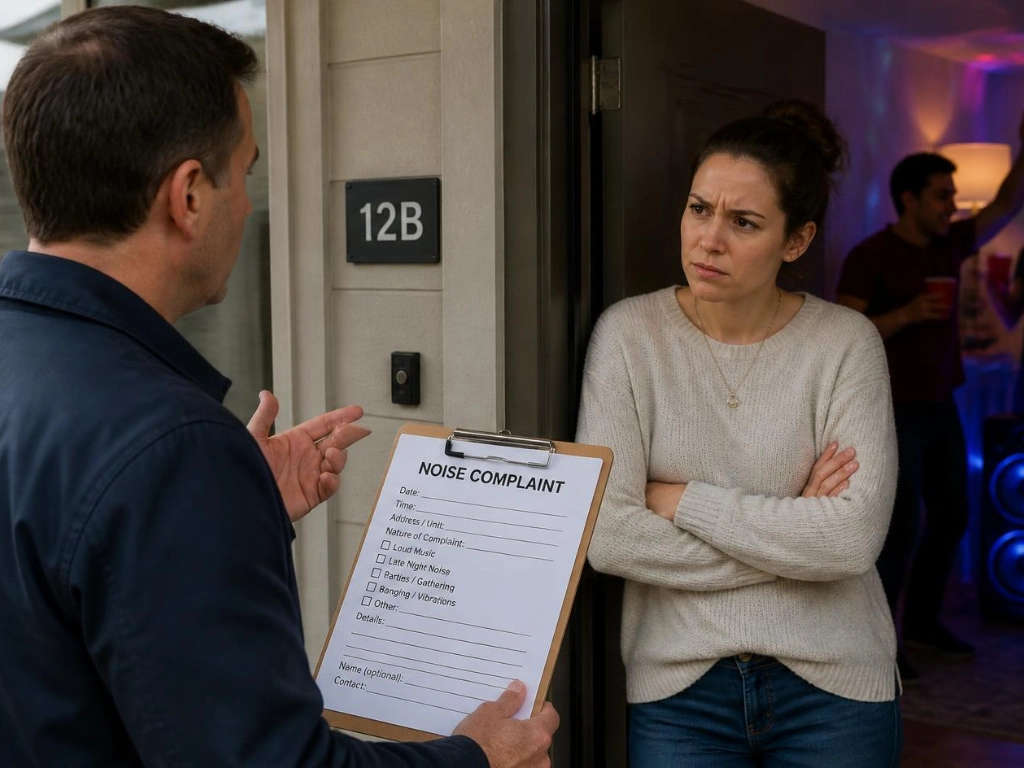
A noise complaint in the United States is usually handled by a city, county, landlord, property manager, HOA, or local law-enforcement agency rather than one nationwide office. The right place to report the problem depends on whether you are dealing with a loud party, repeated apartment noise, construction, barking dogs, commercial equipment, or a situation involving immediate danger. Because local ordinances differ, checking the rules where you live is the most useful first step.
| Situation | Best place to start | Information to have ready |
| Loud party happening now | 311 or local police non-emergency line | Address, time, type of sound |
| Repeated apartment noise | Landlord or property manager | Incident log, lease rules, written reports |
| Construction or machinery | Code enforcement or local noise office | Address, dates, operating hours |
| Repeated barking | Animal control, code enforcement, or local reporting service | Dates, duration, location |
| Business or commercial noise | Code enforcement or municipal noise office | Business address, times, pattern |
| Violence or immediate danger | 911 | Location and details of the emergency |
To file a noise complaint in the U.S., check your local noise rules, document the time and source, and use 311, code enforcement, or the police non-emergency line for a non-dangerous disturbance. Call 911 only when the situation involves immediate danger, violence, or another genuine emergency.
Key Takeaways
- Noise rules are primarily enforced at the state and local level.
- Check your city or county ordinance before assuming a sound violates the law.
- Keep a dated record if the disturbance happens repeatedly.
- Use 311 or a police non-emergency number where those services handle local disturbances.
- Renters should consider reporting recurring problems to property management in writing.
- Anonymous reports may be allowed, but anonymity can limit follow-up or enforcement in some cities.
- Treat threats, violence, or other immediate safety risks as emergencies.
What Counts as Excessive Noise in the United States?
There is no single nationwide quiet-hours rule that applies to every American home. The federal Noise Control Act recognizes noise as a public welfare issue, but the EPA explains that primary responsibility for controlling community noise rests with state and local governments. Your city or county may regulate sound by time of day, source, duration, decibel level, location, or a broader standard such as unreasonable disturbance.
That means ordinary daytime activity may be treated differently from amplified music after midnight. Construction, HVAC equipment, animals, vehicles, bars, and residential parties may also fall under different parts of a municipal code. Before reporting a disturbance, search your city or county website for terms such as “noise ordinance,” “noise control,” or “municipal code.”
For readers researching other U.S. rules and public institutions, NewsHeck’s Law section provides additional plain-English legal coverage. Local rules still control your specific situation, so official city or county guidance should take priority over a general online explanation. This article provides general information rather than legal advice.
How to File a Noise Complaint in 7 Practical Steps
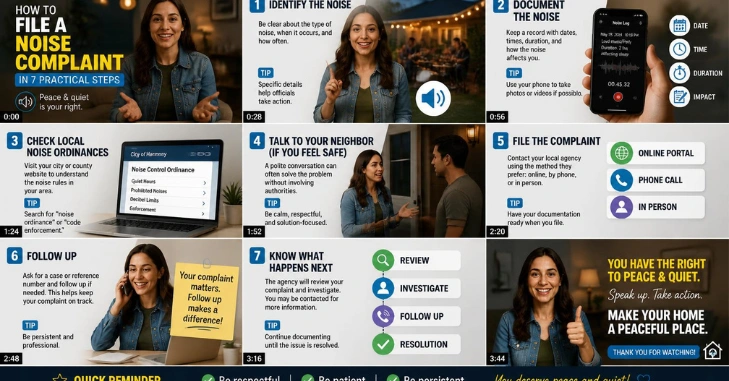
A noise complaint good report gives the receiving agency enough factual information to understand what is happening and determine whether its rules apply. You do not need to turn a neighborhood problem into a legal case before making your first report, but organized information helps when the disturbance repeats. The following sequence works as a practical starting point in many U.S. communities.
- Check the local ordinance. Find out whether your city or county has quiet hours, source-specific restrictions, or measurable sound limits.
- Consider direct communication when it is safe. A polite conversation may resolve an unintentional problem without involving an outside agency.
- Start an incident log. Record the date, start and end time, source, location, and how the disturbance affected your household.
- Identify the correct authority. Depending on the problem, that may be 311, police non-emergency dispatch, code enforcement, animal control, property management, or an HOA.
- Report facts rather than assumptions. Give the address, type of sound, duration, current status, and any repeated pattern.
- Save the case or reference number. A reference number makes later follow-up easier and connects repeated reports.
- Follow up through the appropriate channel. Persistent problems may require further documentation, another inspection, landlord action, mediation, or local legal guidance.
Talking with a neighbor first is not appropriate in every situation. If the person has threatened you, acted violently, or made you fear for your safety, avoid a confrontation and choose a safer reporting method. Noise disputes can become personal quickly, so resolving the sound problem should never require putting yourself at risk.
Who Should You Call About Loud Noise?
For an active but non-dangerous disturbance, many communities direct residents to a 311 service or the local police department’s non-emergency number. New York City, for example, accepts reports of neighbor noise through its 311 system while directing emergencies involving danger, gunshots, explosions, or similar threats to 911. Your own municipality may divide responsibility differently, so verify its instructions before calling.
Chronic problems may be better suited to code enforcement or another municipal department. Construction outside permitted hours, recurring commercial equipment, or mechanical systems can involve inspection rather than an immediate police response. A city website or non-emergency dispatcher can usually tell you which department handles the specific source.
| Type of disturbance | Possible reporting route |
| Party, music, yelling | 311 or police non-emergency |
| Construction | Code or building enforcement |
| Barking dog | Animal control or local code office |
| Apartment neighbor | Property manager, landlord, or local authority |
| Restaurant, bar, machinery | Code enforcement or municipal noise office |
| Immediate threat | 911 |
Property-related disputes often overlap with housing issues, so renters and owners can also browse NewsHeck’s Real Estate section for related housing material. The correct enforcement authority is still determined locally. Do not assume that a reporting method used in another city will work in yours.
What Renters and HOA Residents Can Do
Renters have an additional reporting channel because a lease or building policy may contain quiet-hour or nuisance provisions. USAGov recommends reading your lease carefully when dealing with a landlord dispute and points tenants toward state agencies that explain local renter rights. Send recurring complaints to management in writing so you have a dated record of what you reported and when.
Your message should describe the incidents without exaggeration and identify any relevant lease rule. Include your log if the problem has happened more than once, and keep copies of emails or letters. If management does not respond, state tenant-rights resources or local legal-aid organizations can explain remedies available where you live.
HOA residents should also review their community rules because an association may regulate quiet hours or recurring disturbances independently of municipal law. A violation of HOA rules does not automatically mean a city ordinance has been broken, and the reverse can also be true. Follow the complaint procedure written into the association’s governing documents.
Can You Report the Problem Anonymously?
Anonymous reporting policies vary from one jurisdiction to another. Some agencies accept an anonymous tip, while others need your name or access to the affected property before investigators can gather evidence. Albuquerque, for example, explains that anonymous reporting can limit enforcement because its noise-measurement process may require access to the property affected by the sound.
Ask the agency about confidentiality before submitting details if retaliation is a concern. Providing contact information may allow an inspector or officer to ask follow-up questions, but public-record rules and disclosure policies differ by jurisdiction. Do not assume your identity will remain confidential unless the agency explains its policy.
What Evidence Should You Keep?
A simple written log is often more useful than a vague statement that a neighbor is always loud. Record dates, approximate start and stop times, the type of sound, where you heard it, and whether it interrupted sleep, work, or ordinary use of your home. Photos or recordings may provide additional context when permitted, but the local agency decides what evidence it will consider.
Be careful when recording conversations rather than environmental sounds. Federal and state rules governing private conversations can differ, and some states impose stricter consent requirements than federal law. The Reporters Committee for Freedom of the Press maintains a state-by-state recording-law guide and warns that these rules can carry criminal or civil consequences.
You can also explore NewsHeck’s Home Improvement section if reducing sound transmission inside the property becomes part of the solution. Rugs, furniture placement, door seals, and other changes may reduce ordinary sound, but they do not replace enforcement when a genuine local violation continues. The goal is to separate preventable household sound from conduct that requires outside intervention.
What Happens After You Make a Report?
The first response depends on the agency and whether the disturbance is still occurring. An officer may visit an active incident, while a code-enforcement department may review the report, request more information, or schedule an inspection. A warning is possible in many situations, but citations, fines, follow-up procedures, and proof requirements depend on the local ordinance.
Do not assume that one report guarantees immediate action. The sound may stop before anyone arrives, an inspector may need to observe a recurring pattern, or the reported behavior may fall outside the ordinance. Keep the reference number and continue your factual log if the problem returns.
For animal-related disturbances, the enforcement path can be different from residential music or construction. Local animal-control rules may address repeated barking, while another department handles other neighborhood sounds. NewsHeck’s Pets section is another internal resource for general animal-related reading.
When a Noise Problem Becomes a Safety Problem
Ordinary unwanted sound should generally use non-emergency reporting channels. If you hear or witness violence, gunshots, a serious threat, or another situation in which someone appears to be in immediate danger, the issue is no longer simply about sound. In that situation, follow your local emergency guidance and call 911 when emergency assistance is needed.
If a neighbor becomes threatening after you report them, document the conduct separately from the original disturbance. Avoid escalating the confrontation yourself, and tell the appropriate authority about threats or intimidation rather than describing them only as another sound issue. Keeping separate records makes it easier to explain what happened and when.
A Practical Next Step
Start by finding the official noise rules for your city or county and saving the correct non-emergency reporting contact before the next incident occurs. If you need to file a noise complaint, keep a simple log when the disturbance is recurring, and report facts rather than anger or guesses about the person responsible. A calm record of the source, timing, duration, and prior reports gives landlords and local officials much clearer information to work with.
Frequently Asked Questions
Can I make a noise complaint anonymously?
Possibly, because the answer depends on the city, county, and agency handling the report. Some departments accept anonymous information, while others need contact details to investigate or obtain measurements from the affected property. Ask about confidentiality and public-record rules before filing if protecting your identity is important.
Should I call 911 for loud neighbors?
Usually not when loud sound is the only problem and nobody appears to be in danger. A 311 service, code office, or local police non-emergency number is commonly the better starting point where those services are available. Call 911 when the circumstances involve an immediate emergency rather than a routine neighborhood disturbance.
Does daytime noise automatically mean no rule was broken?
No, because local ordinances can regulate more than nighttime quiet hours. A city may restrict certain construction, machinery, amplified sound, or unreasonable disturbances during the day as well. Check the actual ordinance instead of relying on a general rule about what hours should be quiet.
Can my landlord help with a noisy apartment neighbor?
Yes, particularly when the lease or building rules restrict disruptive behavior. Put recurring problems in writing, include dates and times, and ask management to address the relevant lease provision. USAGov also recommends checking your lease and using state tenant-rights resources when a landlord dispute cannot be resolved directly.
What if authorities do not solve the problem?
Continue keeping accurate records and follow the agency’s stated appeal or follow-up process. Depending on the circumstances, other options may include property management, an HOA, community mediation, a tenant-rights organization, or advice from a local attorney. Because nuisance and housing law vary substantially by state and city, get location-specific legal guidance before taking steps such as withholding rent or starting a lawsuit.
