


Ongo Gablogian is Frank Reynolds’ outrageous art-critic persona from It’s Always Sunny in Philadelphia. Danny DeVito introduces the disguise during the Season 11 episode “Dee Made a Smut Film.” The brief appearance became one of Frank’s most recognizable alter egos.
The character works because Frank treats ridiculous opinions as unquestionable artistic judgment. His white wig, glasses, dramatic voice, and instant dismissals parody an exaggerated art-world gatekeeper. Years later, the joke has moved beyond television into fan art, merchandise, memes, and street art.
Ongo Gablogian at a Glance
| Detail | Information |
|---|---|
| Character | Frank Reynolds in disguise |
| Actor | Danny DeVito |
| Series | It’s Always Sunny in Philadelphia |
| Main episode | “Dee Made a Smut Film” |
| Season and episode | Season 11, Episode 4 |
| U.S. release date | January 27, 2016 |
| Persona | Eccentric contemporary-art critic and collector |
| Famous reaction | “Derivative!” |
| Purpose in episode | Help influence how people value Charlie’s artwork. |
| Later legacy | Memes, merchandise, fan art, and U.S. street art |
Direct answer: Ongo is Frank Reynolds pretending to be an eccentric contemporary-art expert in It’s Always Sunny in Philadelphia. The persona appears prominently in “Dee Made a Smut Film,” where Frank’s absurd confidence helps satirize artistic taste, reputation, and the strange ways people decide what art is worth.
Key Takeaways
- Frank Reynolds creates the persona while the Gang debates what makes something legitimate art.
- Danny DeVito plays the character with an exaggerated appearance and deliberately pretentious behavior.
- The character appears in Season 11, Episode 4, which aired in the United States on January 27, 2016.
- The joke targets art-world status, subjective taste, and the power of confident opinions.
- The persona later inspired merchandise, independent artwork, memes, and public street art.
Who Is Ongo Gablogian in It’s Always Sunny?
Ongo Gablogian isn’t a separate person in the show’s larger story. He is another disguise adopted by Frank Reynolds, played by Danny DeVito. Frank creates the identity when Mac and Charlie need someone who appears knowledgeable about contemporary art.
The disguise turns Frank into an exaggerated cultural tastemaker almost immediately. He wears a distinctive white wig and large glasses while using a theatrical voice. The appearance resembles a broad parody of fashionable art-world personalities.
Frank’s actual artistic expertise matters less than everyone’s reaction to his confidence. He makes sweeping judgments without giving serious explanations for them. That mismatch between certainty and knowledge creates much of the comedy.
Newsheck readers who enjoy fictional-character breakdowns can also read the site’s recent Nancy Downs character profile. Newsheck’s entertainment section covers more television, film, celebrity, and pop-culture subjects. Its Tyler Mahoney profile also offers another example of television-focused coverage.
Which Episode Introduces Frank’s Art-Critic Persona?
The key appearance happens in “Dee Made a Smut Film,” Season 11, Episode 4. Apple TV lists the episode as released on January 27, 2016. Its synopsis describes Frank and Mac trying to market Charlie as a talented artist for profit.
The episode begins with a wider argument about artistic legitimacy and commercial value. Dee believes a film appearance has artistic merit, while other characters challenge that claim. A second storyline then tests how easily reputation can shape reactions to visual art.
Mac and Frank become involved in promoting Charlie’s unusual drawings. Frank’s disguise gives their plan the appearance of outside validation. His supposed expertise helps turn the episode’s argument about taste into a practical experiment.
The episode runs about 21 minutes on Apple TV. IMDb also identifies it as Season 11, Episode 4. Both sources place its original U.S. release on January 27, 2016.
What Is the Joke Behind the Character?
The central joke is that artistic authority can appear convincing when someone performs confidence well enough. Frank barely needs evidence to dismiss work or praise something unexpected. The people around him still respond to the performance of expertise.
That idea fits the episode’s larger argument about how society decides something qualifies as art. Price, reputation, presentation, and influential approval can affect perception. The episode pushes those ideas into absurd territory through Frank’s behavior.
One famous moment involves his sharp dismissal, “Derivative!” The line became memorable because it reduces serious criticism to a single confident verdict. Fans can repeat it whenever they want to jokingly imitate an impossible-to-please critic.
The satire does not require viewers to dislike contemporary art. Instead, it targets empty status signals and unquestioned authority. Frank becomes funny because he behaves like the final judge despite having no credible qualifications.
Why Does the Costume Look So Familiar?
The character’s white wig, dark clothing, and oversized glasses give Frank an instantly recognizable silhouette. Several commentators have compared the visual joke with familiar images of famous art personalities. The show exaggerates those associations rather than building a realistic professional critic.
The costume also lets DeVito change Frank’s physical presence without hiding him completely. Viewers can still recognize Frank beneath the styling. That contrast makes his sudden sophistication appear even more ridiculous.
His voice completes the disguise. Frank speaks with an affected rhythm that differs from his usual delivery. Every movement tells viewers that he believes the performance is working perfectly.
Why Did the Bit Become So Memorable?
The character appears within a compact storyline, so the joke never needs extensive background. Viewers understand the disguise, its purpose, and Frank’s personality within minutes. That simplicity makes the scene easy to remember and share.
The dialogue also produces short reactions that work outside the original episode. Fans can use them when discussing movies, paintings, clothes, food, or practically anything subjective. That adaptability helped the character survive beyond a single television broadcast.
Danny DeVito’s performance gives the material another advantage. Frank already has a history of sudden schemes and strange identities. Turning him into an arrogant art authority therefore feels surprising without feeling disconnected from the character.
Official merchandise provides another sign of that continued recognition. The FX Networks shop has sold clothing, hats, and mugs based on the persona. A joke from a 2016 episode has therefore remained commercially recognizable a decade later.
How the Character Inspired Real Street Art
The strangest part of the character’s legacy may be its connection with San Francisco street art. A Mission District artist adopted the name “Ongo” and developed a recurring figure inspired by Frank’s disguise. Reports in 2026 described the image appearing on walls, signs, sidewalks, and other urban surfaces.
The anonymous artist began painting during the pandemic and eventually made the figure a recurring personal symbol. The street-art version uses the wig and hypnotic-looking glasses as recognizable visual cues. Its simplified body turns the television reference into a distinct public-art character.
This creates an unusual loop between fictional art criticism and real art. A sitcom persona created to parody artistic pretension eventually inspired an actual working street artist. That outcome gives the original joke a cultural afterlife few television disguises receive.
The connection is particularly fitting because the episode questions who can define art. Years later, viewers can encounter an interpretation of that character outside a traditional gallery. The parody became part of the kind of artistic conversation it originally mocked.
Fan Art and the Character’s Wider Cultural Life
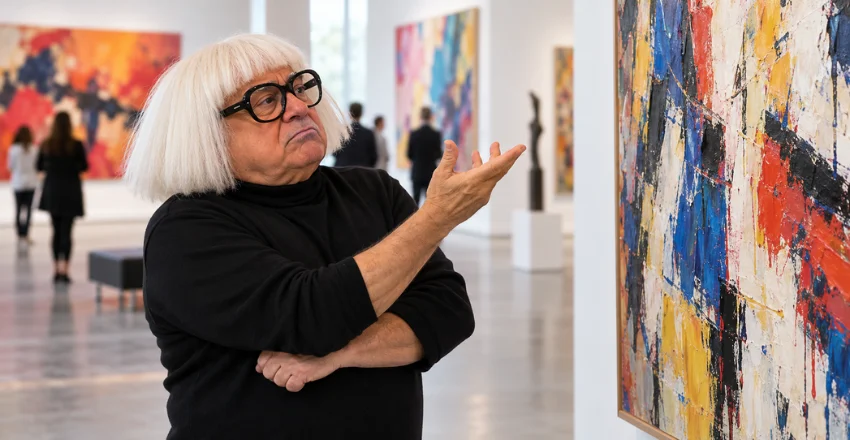
Independent artists have also recreated the character through painting, digital sculpture, embroidery, and prints. That activity shows how strongly the visual design works without the original episode around it. The wig and glasses alone can signal the reference to longtime fans.
A 2020 Philadelphia public artwork offered another example. Baltimore artist REED Bmore created a wire sculpture depicting Danny DeVito’s art-critic disguise. The work appeared in South Philadelphia and received local media attention.
Digital artists have approached the character differently. Some projects reproduce DeVito’s facial expression in detailed three-dimensional models. Others emphasize the exaggerated costume rather than realistic likeness.
These interpretations give the joke a second life through the medium it originally mocked. The persona started as a fake authority discussing visual art. It later became the subject of genuine visual art made by people who enjoyed the joke.
Why the Episode Still Works Years Later
Questions about artistic value have not disappeared since the episode aired in 2016. People still debate whether reputation, scarcity, technique, marketing, or institutional approval determines value. The episode turns that complicated discussion into an intentionally ridiculous scheme.
Social media has made those questions even easier to recognize. A confident opinion can gain authority through visibility before expertise gets examined. Frank’s performance feels familiar because audiences regularly see certainty rewarded online.
The scene also avoids requiring specialized knowledge from viewers. You do not need an art-history background to understand what Frank is doing. The humor comes from watching an obvious fraud receive attention because he looks and sounds authoritative.
That combination explains much of the character’s staying power. The costume is memorable, the dialogue is easy to reuse, and the satire remains understandable. Each part supports the others without requiring a long storyline.
Frequently Asked Questions
Who plays Ongo Gablogian?
Danny DeVito plays the persona as part of his role as Frank Reynolds. Frank adopts the identity while trying to influence opinions about Charlie’s artwork. DeVito’s exaggerated delivery makes the brief disguise one of Frank’s better-known alter egos.
What episode is the art-critic scene from?
The main appearance comes from “Dee Made a Smut Film.” It is Season 11, Episode 4 of It’s Always Sunny in Philadelphia. The episode first aired in the United States on January 27, 2016.
Is the character a real art critic?
No, the critic is a fictional persona created by Frank. Frank has no established professional authority that explains his sudden expertise. The lack of genuine credentials forms an important part of the joke.
Why does Frank call art “derivative”?
Frank uses the word as a sweeping negative judgment during his performance. The humor comes from how quickly and confidently he dismisses the work. Fans later adopted the reaction as a reusable joke about anything they consider unoriginal.
Is Ongo connected with a real street artist?
Yes, the fictional persona inspired an anonymous San Francisco street artist who uses the shorter name Ongo. Reports in 2026 described his recurring character across the Mission District. The artist has identified the Always Sunny character as the source of the name and visual idea.
Where can viewers watch the original episode?
Availability can change by country and subscription service. Apple TV currently maintains a U.S. listing for “Dee Made a Smut Film.” Viewers should check the episode’s current streaming availability before subscribing to a service.
A Small Character With an Unusually Long Legacy
Frank’s fake critic lasts only a small portion of a long-running television series. Yet the disguise became recognizable enough to inspire merchandise, artwork, street pieces, and years of fan references. Its staying power comes from a joke that works even without detailed knowledge of the show. We cover this in more depth in Timothy Reynolds.
The scene mocks certainty, prestige, and the strange mechanics behind cultural value. Those themes remain familiar well beyond galleries or television comedy. Frank simply turns them into a character viewers can identify within seconds.
For more television and film character explainers, readers can continue through Newsheck’s entertainment coverage. The site already covers cult characters, performers, and long-running pop-culture stories. That makes this peculiar art critic a natural addition to the collection.
—–
